
The window
The SDE++ 2026 round opened on 27 October and closes at 17:00 on Thursday 26 November, with a total budget of €8 billion. It runs in five phases, each setting the maximum subsidie-intensiteit you can request.
- Phase 1: 27 October to 2 November, maximum €75 per tonne
- Phase 2: 2 November to 9 November, maximum €150 per tonne
- Phase 3: 9 November to 16 November, maximum €225 per tonne
- Phase 4: 16 November to 23 November, maximum €300 per tonne
- Phase 5: 23 November to 26 November, €400 per tonne for projects inside a hekje and €300 per tonne otherwise
All times are 17:00 Dutch time, apart from the opening, which was 09:00.
How applications are ordered, which isn't what most people assume
This is the part worth getting right, because the common assumption is wrong.
SDE++ doesn't rank the whole round by subsidy intensity and fund the cheapest projects first. Within a phase, applications are handled in order of arrival (volgorde van binnenkomst). Subsidy intensity only comes in as a tie-breaker when applications received on the same day exceed the budget available.
That has two consequences for a phase 3 application.
First, being early within phase 3 matters. Not early in the round, but early in the phase. An application submitted shortly after 17:00 on Monday 9 November sits ahead of one submitted that Friday, and the order is set before anyone looks at how cheap your project is.
Second, the risk you're carrying is the budget running out rather than being outbid. Whatever phases 1 and 2 absorb is gone by the time phase 3 opens, and phase 3 competes for what's left. A strong project submitted late in the week is in a materially worse position than the same project submitted on Monday evening.
If precision matters to your bid, the governing rules are the ones published in the Staatscourant, not any summary, including this one.
Where electrified steam sits in the scheme
SDE++ ring-fences parts of its budget into categories (hekjes), so technologies compete within a category rather than against everything at once.
Lagetemperatuurwarmte covers restwarmtebenutting and the industriële warmtepomp met gesloten systeem. Hogetemperatuurwarmte covers the grootschalige e-boiler and procesgeïntegreerde warmtepompen.
It's the category that puts you in a hekje, not the temperature your project happens to run at, and that catches people out.
What the e-boiler category asks of you
- A minimum capacity applies.
- An efficiency requirement applies, usually 99% for an e-boiler.
- Dual metering is required, so gas and electricity consumption can be measured separately.
- Your correctiebedrag is driven by the electricity market, so a scenario analysis of power prices is strongly advised, including hours of negative EPEX pricing.
That last point is the one most likely to decide whether the project works. The subsidy covers the gap between your basisbedrag and the correctiebedrag, and the correctiebedrag moves with the power price. A project whose economics assume you buy electricity at the average price is a very different project from one that can choose when it buys.
Where storage changes the numbers
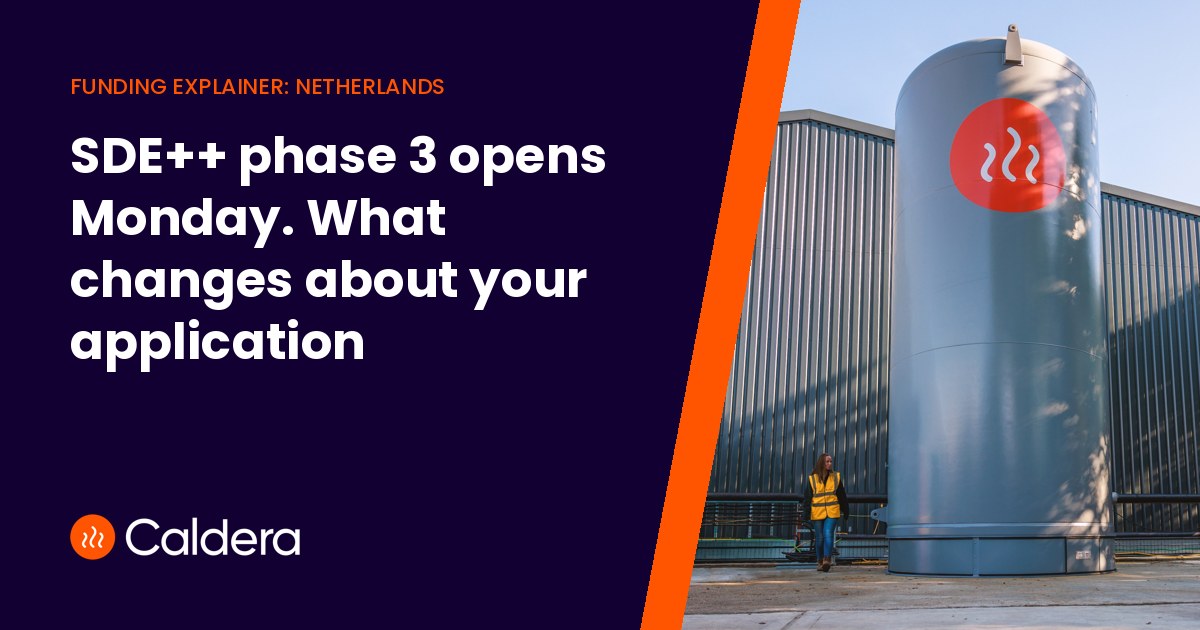
A Caldera Storage Boiler is an electric boiler with thermal storage and controls built in. Because charging and discharging are decoupled, the hour you buy power and the hour you raise steam no longer have to be the same.
Your import is sized to your average load rather than your peak steam demand. With netcongestie making connection upgrades slow, and in places unavailable, that's often the difference between a project that can start and one that waits years for capacity.
You can also concentrate consumption into the cheapest hours, including hours with negative prices, which is exactly the scenario the scheme asks you to analyse.
It delivers saturated steam at up to 16 barg (204°C), over 95% dry, with a discharge response of under 60 seconds. It integrates directly with your existing steam plant and runs alongside your current boilers, so you can turn a gas boiler down rather than switch it off.
Before you assume it qualifies
Eligibility under the grootschalige e-boiler category is for RVO and your own adviser to confirm. Our team will work through the category requirements with you and supply the technical evidence your application needs.
We'll also model your site on real data. Send us twelve months of half-hourly demand data and we'll simulate a Storage Boiler across all 8,760 hours of a year against real price signals, then take you through the results.
With phase 3 opening on 9 November, time is short, so get in touch this week.
About this analysis
Dates, budget and phase structure are from RVO's SDE++ application page, checked on 6 November 2026: the round opens on 27 October 2026 at 09:00 and closes on 26 November 2026 at 17:00, with a total budget of €8 billion and five phases with maximum intensities of €75, €150, €225, €300 and €400 per tonne of CO2.
The phase 5 split (€400 per tonne inside a hekje, €300 otherwise), the arrival-order rule and the e-boiler conditions are from Dutch-language scheme guidance published by sdetool.nl. That source names the Staatscourant publication as the governing reference, and so do we.
We haven't given a basisbedrag or correctiebedrag for the e-boiler category because we haven't been able to verify one.
Nothing here is a claim that a Caldera Storage Boiler qualifies under the grootschalige e-boiler category, and no Caldera system has yet been through an SDE++ award. The product specifications are Caldera's published figures. Caldera's industrial-scale demonstrator at Fareham has met its targets every year since 2024.
