
The number, and what it actually tells you
On World Bank data, European gas averaged $11.76 per mmbtu in January 2026 and $21.11 in August, a rise of almost 80%.
What most commentary leaves out is how calm prices had been until the summer. In the four quarters to June 2026, they sat in a narrow band: roughly €33/MWh in Q3 2025, €30 in Q4, around €40 in Q1 2026 and around €36 in Q2. The sharp move came after that, driven by the closure of the Strait of Hormuz and the conflict with Iran, and gas has been repricing on diplomatic headlines ever since.
So this is a spike rather than a trend, and if Hormuz reopens the price could well fall back. Measured from last September in euro terms, as in the chart below, the rise is over 90%.

We're saying that plainly because the argument that follows doesn't depend on the spike. The case for controlling when you buy energy held at €30/MWh, and it still holds at September's spot price of around €73.
The exposure is the problem, not the price
If you raise steam from gas or fuel oil, you buy fuel at the moment your process needs heat. The market sets the price and you absorb whatever it does next. Good procurement can soften that, but it can't change the basic shape of it.
That exposure is structural. A hedge changes when you feel a price rise; it doesn't give you any choice about when you buy.
“But our electricity is priced off gas anyway”
It's a fair objection, and the honest answer is: partly, and less than it used to be.
Gas still sets the power price at the margin in many hours, but the link is loosening, and Spain shows it most clearly. Analysis published by Bruegel in April 2026, drawing on work by Ember, found that gas now sets the Spanish power price in 15% of hours, down from 75% in 2019. Spain has come through the current shock considerably better than Italy, where gas sets the electricity price around 90% of the time. Bruegel's own forecast (and it is only a forecast) puts Spain's average electricity price for the rest of 2026 at roughly half of Italy's.
The direction of travel matters more than any single figure. As more wind and solar capacity joins European grids, gas sets the price in fewer and fewer hours.
Electricity has cheap hours. Gas delivered to a burner doesn't
Power is priced hour by hour, so there are always cheaper hours: overnight, at weekends, and whenever wind and solar are plentiful. In some markets prices even go negative. A site that can only use energy at the moment it needs heat can't reach any of those hours, but a site that can store heat can.
What storage changes
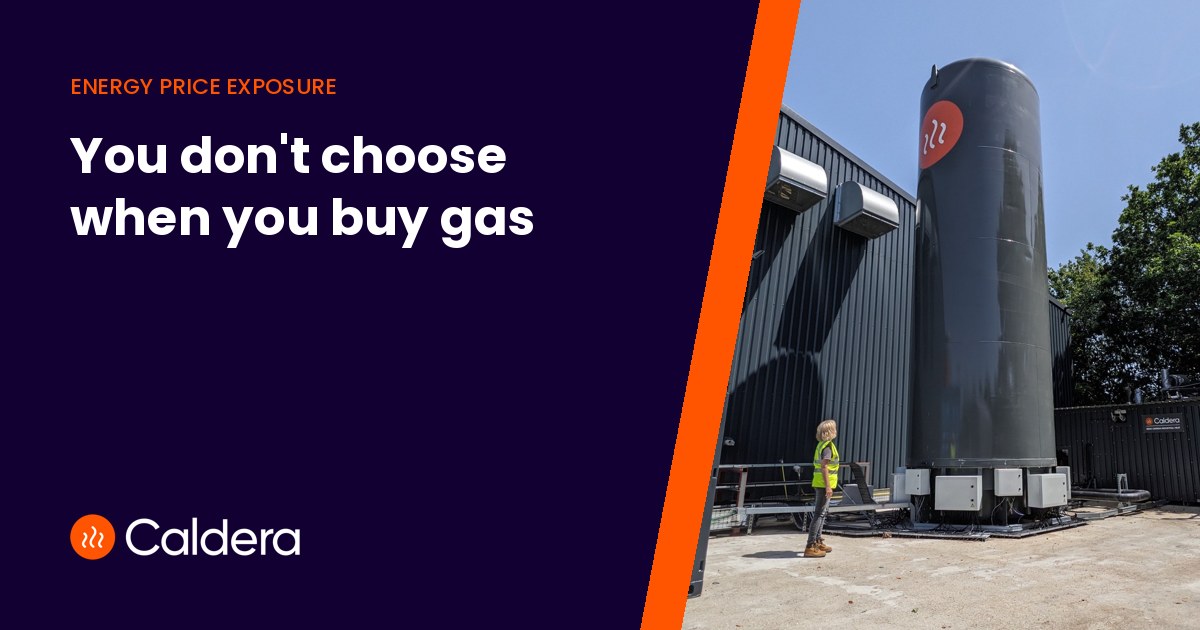
A Caldera Storage Boiler is an electric boiler with thermal storage and controls built in. It charges when electricity is cheap and delivers saturated steam on demand at up to 16 barg (204°C), over 95% dry, with 94% round-trip efficiency and a discharge response of under 60 seconds.
Because charging and discharging are decoupled, three things change:
- You buy power when it's cheap rather than when the process needs heat. Charging is scheduled, and steam is there whenever the process calls for it.
- Your electrical import is sized to your average load rather than your peak steam demand. That's what lets many sites electrify within the grid connection they already have, instead of waiting for an upgrade.
- Your capacity charges follow your peak import, and your peak import becomes something you set.
You don't have to rebuild your steam system
The Storage Boiler integrates directly with your existing steam plant and runs alongside your current boilers, so you can turn a gas boiler down rather than switch it off.
It also means you can phase it in. Start with the share of your heat you can move to off-peak hours (often 20 to 40%), keep your existing boilers covering the rest and as backup, and add Heat Cells as the case builds. Each Heat Cell stores 5 MWh with 2 MWe of charging, and systems scale from 5 MWh to beyond 100 MWh.
Test it before you commit capital
Whether this works on your site depends on your load shape and your tariff, so we'll model it on your numbers. Send us twelve months of half-hourly demand data and we'll simulate a Storage Boiler across all 8,760 hours of a year against real price signals, then take you through the results.
You're also welcome to come and see one running at our factory in Fareham.
About this analysis
Gas prices are from the World Bank Commodity Price Data (The Pink Sheet), series 'Natural gas, Europe', which the World Bank defines as the Dutch Title Transfer Facility (TTF) benchmark. They are monthly averages in US$ per mmbtu, taken from the April, June, August and September 2026 issues; where months overlap, the issues agree. Published under CC BY 4.0.
The quarterly €/MWh figures are official TTF averages. The September 2026 spot level of roughly €73/MWh is a market reading rather than a monthly average, so the two aren't directly comparable. That's why the headline figure uses completed monthly averages only.
The Spanish and Italian power price figures are from Keliauskaitė, U., B. McWilliams, T. Mramor, A. Roth, S. Tagliapietra and G. Zachmann (2026), 'How Europe should respond to the Iran gas shock – and how it shouldn't', Analysis 07/2026, Bruegel, 1 April 2026. Bruegel attributes the 75% to 15% figure to Ember (Rosslowe, C. and B. Petrovich, 2026).
We have not made any forecast of where gas prices go next.
